
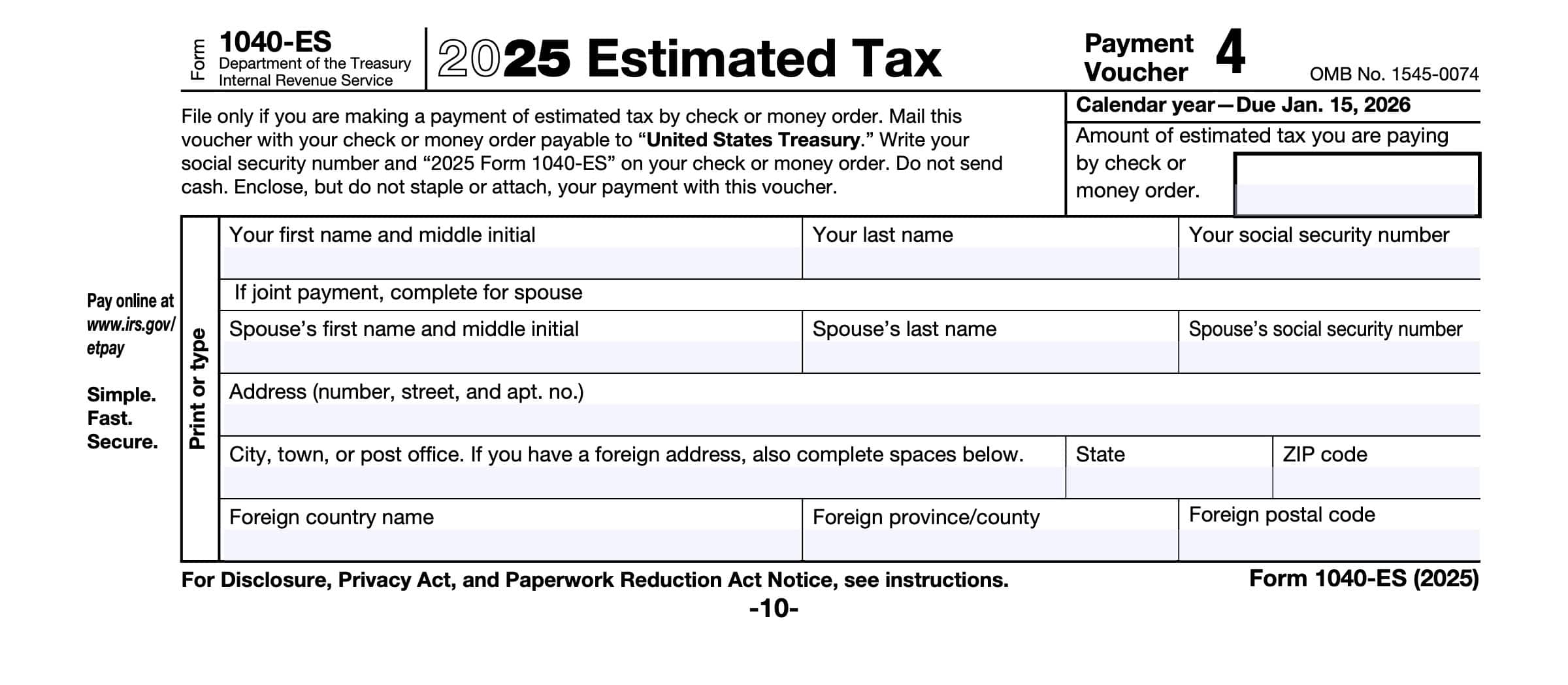
As a small-business owner, staying on top of taxes is crucial. The U.S. tax system is pay-as-you-go, meaning the IRS expects you to pay taxes on income as you earn it. For many entrepreneurs, that means making quarterly estimated tax payments, since business profits and other non-wage income aren’t subject to payroll withholding. Estimated taxes cover income tax, self-employment tax, and other taxes on earnings that have no automatic withholding. In short, if you run a business or have significant untaxed income, you’ll likely need to make these payments throughout the year.
Who Needs to Pay Estimated Taxes?
You generally must pay estimated taxes if you expect to owe $1,000 or more in tax when you file, after subtracting any withholdings and creditsirs.gov. This applies to sole proprietors, LLCs (unless taxed as corporations), partners, and S-corporation shareholders. In practical terms, this means:
- Self-employed/sole proprietors: If your business profits (on Schedule C) plus other untaxed income (interest, dividends, rental, etc.) will leave you owing over $1,000, you must pay estimates.
- Partnerships and multi-member LLCs: Each partner reports their share of profit on Schedule K-1 and pays estimated taxes individually on that income.
- S-Corporations: Although an S-corp itself doesn’t pay income tax, owners (shareholders) pay tax on their share of corporate profit. If a shareholder’s tax liability (after withholding from any salary) will be ≥$1,000, they should pay estimated taxes.
- LLCs taxed as corporations: If an LLC elects C-corp status, the corporation must pay estimated tax on its own corporate income (the threshold here is $500).
- Employees with side income: If you have a W-2 job and also freelance or receive side income, remember all those extra earnings count. If your withholdings don’t cover 90% of your current-year tax (or 100% of last year’s tax), you’ll owe estimated payments.
In short, LLCs do pay estimated taxes if their owners will owe tax on business income. An LLC treated as a sole prop or partnership means the owners pay just like above. Only in rare cases (e.g. an LLC taxed as a C-corp) does the business entity pay directly. If you’re unsure, a good rule is: ask, “Will I owe more than $1,000 when I file?” If yes, plan to make estimated payments.
2025 Estimated Tax Deadlines for Small Businesses
Keep these key IRS deadlines on your calendar for tax-year 2025 estimated payments:
- 1st Quarter: Covers Jan. 1–Mar. 31, 2025 – Payment due April 15, 2025.
- 2nd Quarter: Covers Apr. 1–May 31, 2025 – Payment due June 16, 2025. (Note: June 15, 2025 falls on a weekend, so the deadline is Monday, June 16.)
- 3rd Quarter: Covers June 1–Aug. 31, 2025 – Payment due September 15, 2025.
- 4th Quarter: Covers Sept. 1–Dec. 31, 2025 – Payment due January 15, 2026.
These are the standard quarterly due dates for most individuals and businesses. (There are special rules for farmers, fishermen, and higher-income taxpayers with unequal income.) If any due date falls on a weekend or holiday, the deadline moves to the next business day. Mark these dates early and set reminders – paying on time avoids unnecessary penalties.
How to Calculate Estimated Taxes
Calculating your estimated payments starts with estimating your annual income and tax liability. Here are the basic steps:
- Estimate total income: Add up expected revenue from your business (net profit), plus any other taxable income (interest, dividends, rental income, capital gains, etc.). Don’t forget to include side gigs or contract work.
- Estimate deductions and credits: Subtract business expenses, retirement contributions, personal deductions and credits. Using last year’s tax return as a guide can help make this easier.
- Use Form 1040-ES worksheet: The IRS provides Form 1040-ES with worksheets to calculate your tax. “First, determine your expected adjusted gross income (AGI), taxable income, taxes, deductions, and credits for the year. Then follow the instructions on the Form 1040-ES worksheet to assist you”. This tool (or tax software) will compute your total tax for the year.
- Divide into quarterly payments: Once you have your annual tax estimate, divide by four (or use the annualization worksheets if your income varies) to set each quarter’s payment. Adjust as needed if your income changes during the year.
You can also use online calculators or the IRS’s Tax Withholding Estimator to double-check your numbers. Many small businesses use accounting software or spreadsheets to track income and make projections. The key is to be as accurate as possible: if you overpay, you’ll get a refund; if you underpay, you may owe penalties. For detailed guidance, see IRS Publication 505 (Tax Withholding and Estimated Tax).
How to Pay Estimated Taxes
The IRS offers multiple ways to submit your estimated tax payments:
- Mail with Form 1040-ES vouchers: The traditional method is to fill out the coupon pages in Form 1040-ES and mail them with a check or money order. Write your SSN and “Form 1040-ES” on the payment.
- Online via IRS Direct Pay: You can pay electronically on IRS.gov using Direct Pay (for individuals) or Direct Pay for businesses. This is free and records the payment instantly.
- EFTPS (Electronic Federal Tax Payment System): Small businesses and individuals can use EFTPS to schedule payments by phone or online. EFTPS supports businesses as well as individuals. (You need to enroll in EFTPS, which is free.)
- Debit/credit card: Some providers let you pay by card (fees apply). As Kiplinger notes, “You can pay by check, cash, money order, credit card, or debit card” when using Form 1040-ES, and “online payment options [like] EFTPS” are also available.
- Mobile/IRS2Go: The IRS2Go app offers a convenient way to make payments by phone or mobile device.
- Your bookkeeping/accounting software: Many small-business accounting platforms have built-in tools to track and pay taxes, which can simplify the process.
You can pay more frequently than quarterly (weekly or monthly) if that helps your cash flow, as long as the full amount is paid by the end of each quarter. Always keep proof of payment (printouts or IRS payment confirmations) in case you need to verify on your tax return.
Penalties for Underpaying or Missing Estimated Taxes
It’s important to be timely and accurate: the IRS imposes penalties and interest for underpaid or late estimated taxes. For example, Kiplinger cautions: “Failing to pay enough taxes during the year can lead to IRS penalties. Even if you anticipate a refund when you file, the IRS may penalize late or insufficient estimated tax payments.”. In other words, you can’t rely on a refund to avoid quarterly payments – each quarter’s payment must be on time and sufficient.
Generally, you can avoid penalties if you meet one of the “safe harbor” rules: you owe less than $1,000 in tax after withholdings, or you’ve paid at least 90% of the current year’s tax (or 100% of last year’s tax) through withholding and estimates. Falling short of those thresholds triggers a penalty on the underpayment amount. The penalty isn’t a flat fee; it’s interest on the unpaid tax for the period it was late. Thus, even a few months’ delay can add up.
The takeaway: pay on time and try not to significantly underpay. If your income ends up higher than expected mid-year, you can always adjust your remaining payments. The IRS even allows annualizing income to adjust uneven earnings. But in the end, making accurate estimated payments avoids surprises.
LLCs, Partnerships, and S Corporations: Special Considerations
Different business structures have nuances:
- Sole Proprietorship / Single-Member LLC: Taxed the same way. Use Schedule C on Form 1040, and pay estimated tax on your net profit via Form 1040-ES.
- Multi-Member LLC / Partnership: The partnership files an informational return (Form 1065), but profits pass through to owners. Each partner will receive a K-1 and must pay estimated tax on their share as an individual. Each partner estimates their own tax on the partnership income.
- S Corporation: An S-corp itself usually doesn’t pay income tax. Instead, shareholders (owners) pay tax on their share of corporate income and any salary received. Even S-corps often pay corporate payroll taxes, but owners must separately cover income tax. Owners typically adjust their wage withholding and estimated payments to cover tax on any distributions or pass-through profits. In short, S-corp profits reach your personal return, so estimate accordingly.
- LLC Taxed as C Corporation: If you’ve elected C-corp status, the corporation pays tax on its earnings and must make its own estimated payments (threshold $500). Its owners then pay tax on dividends at the individual level.
The rule of thumb remains: if you (or your business) expect to owe tax above the IRS thresholds, plan for estimates. Consult Form 1040-ES instructions or IRS guidance for the specific filing forms (e.g. Form 1120-W for corporations).
Bottom Line: Stay Ahead with Good Record-Keeping
Estimated taxes aren’t optional for many business owners – they’re the law’s way of making sure taxes are paid throughout the year. The good news is, with some planning and the right tools, the process is manageable. Use IRS worksheets, tax software, or your bookkeeping system to project income and taxes. Set calendar reminders for the April, June, September, and January due dates. And if you’re ever in doubt, the IRS has resources (Form 1040-ES, Pub. 505, Tax Withholding Estimator) to guide you.
Failing to pay sufficient estimated tax can lead to penalties and interest, so it’s wise to be proactive. Review your numbers mid-year and adjust if business is booming or slowing.
If this sounds overwhelming, remember you don’t have to go it alone. Our bookkeeping professionals can help you organize your records so you or your tax professional calculate the right payments and keep you compliant. Contact us today to book a consultation – we’ll ensure your records are clean & correct, on time, and with confidence, so you can focus on growing your business.